
Why Dogs Pull on the Leash: The Real Problem Isn't the Leash
How do you stop your dog from pulling on a leash? How do you stop your dog from lunging and pulling during walks?
7/23/20266 min read
After more than fifteen years of working with dogs and their people, I've noticed something interesting. When people call me because their dog pulls on the leash, they're usually looking for a better tool, a stronger correction, or a technique that will stop the pulling.
But that's rarely where the real solution begins.
One of my favourite sayings is:
You're not managing pulling. You're managing emotions.
Once people understand that idea, everything starts to make more sense.
Most dogs don't pull because they're stubborn or trying to dominate their owners. They pull because they're so excited, overwhelmed, or stimulated that they simply can't make good decisions. Their brains are moving much faster than their bodies can handle.
That's why I encourage people to stop asking:
"How do I stop my dog from pulling?"
and start asking:
"Is my dog calm enough to succeed?"
That small shift in thinking changes the entire approach to training.
Pulling Isn't Really a Leash Problem
One of the biggest misconceptions in dog training is believing that pulling is the behaviour we need to fix.
It isn't.
Pulling isn't really a leash problem. It's an overexcitement problem.
Think about everything your dog experiences the moment you open the front door.
New smells.
Moving cars.
Children playing.
Dogs barking.
Squirrels running.
People walking.
Every one of those things competes for your dog's attention.
For many dogs, especially puppies and adolescent dogs, stepping outside feels a little like dropping a toddler into the middle of a carnival.
They aren't trying to ignore you.
They're simply overwhelmed by everything happening around them.
When we recognize that overexcitement is driving the behaviour, our goal changes. Instead of trying to control the pulling, we begin teaching the dog how to find calm before asking them to walk nicely.
Because here's another Cathy-ism I hope you'll remember:
When calm goes up, good decisions follow.
A Real Story: When Every Walk Ends in Frustration
A few years ago, a couple called me about their ten-week-old puppy.
They also had a wonderful senior dog who had always enjoyed peaceful walks. But the moment the puppy joined the family, everything changed.
Every walk became something they dreaded.
The instant they stepped outside, the puppy exploded with excitement. She barked at everything she saw. She lunged toward people, dogs, leaves, bicycles, and anything else that moved. She jumped, nipped, and pounced on the senior dog from the moment they left the house until they returned home.
By the end of every walk, everyone was exhausted.
The senior dog spent the entire time simply trying to avoid being tackled.
The puppy never had a chance to settle.
And the couple, frustrated and discouraged, often blamed each other.
Sound familiar?
This is one of the most common situations I see.
People assume they have a leash problem.
In reality, they have a dog whose excitement has completely overwhelmed their ability to think.
That's an important distinction.
Most dogs don't pull because they're stubborn. They pull because they're too excited to think clearly.
Once you understand that, your training changes completely.
Calm Comes Before Walking
This family's home was beside one of the busiest parks I've ever worked in.
Children ran through the playground.
Dogs chased balls.
Cyclists flew past.
The splash pad was full.
Tennis courts echoed with activity.
Families gathered for picnics.
For this little puppy, the world wasn't just exciting.
It was overwhelming.
Imagine asking a toddler to sit quietly in the middle of a carnival.
You wouldn't expect success.
You'd expect excitement.
Dogs are no different.
Instead of asking this puppy to ignore everything around her, we taught her something much more valuable.
We taught her how to experience the world without feeling the need to react to every part of it.
That lesson became the foundation for everything that followed.
Because another principle I teach every client is this:
Build calm first, and everything else tends to follow.
We didn't begin by walking.
We began by sitting.
Together we watched the world go by.
The puppy learned that she could notice movement...
without chasing it.
She could see another dog...
without pulling toward it.
She could experience excitement...
without losing herself in it.
Only after she could remain calm while standing still did we begin walking.
And when we did, we kept our expectations small.
Short distances.
Quiet spaces.
Lots of opportunities to succeed.
Success builds confidence.
Confidence builds calm.
And calm creates dogs that make better decisions.
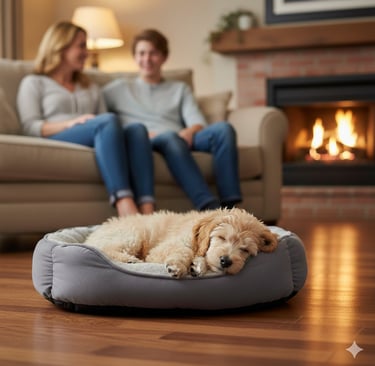
What We Actually Practiced
One of the biggest mistakes I see is that people try to teach loose-leash walking while their dog is already overwhelmed.
By then, it's too late.
A dog who is overexcited isn't refusing to listen. They're simply not in a frame of mind where learning can happen.
That's why we slowed everything down.
Instead of trying to walk through the busiest part of the park, we found a quiet place to sit together.
The puppy watched children play.
She watched dogs pass by.
She watched bicycles roll past.
She watched life happen around her.
Every time she noticed something without reacting, she was learning an important lesson:
I can see something exciting without needing to chase it.
When we were ready to walk, we only took a few steps at a time.
I scattered a few treats beside me in the grass.
She sniffed.
She looked up.
She checked in with me.
Then we walked a little farther.
There was no rush.
Every successful repetition helped her discover that staying connected with her person was more rewarding than reacting to everything around her.
Sometimes the People Need Training Too
The puppy wasn't the only one learning.
Before we started working together, every walk ended the same way.
One person blamed the other.
"You're letting her get too excited."
"You're holding the leash wrong."
That frustration is understandable. When something isn't working, it's easy to look for someone to blame.
So we changed that, too.
One person handled the puppy while the other simply observed.
Then they switched roles.
Something unexpected happened.
Instead of watching for mistakes, they started noticing progress.
They encouraged each other.
They celebrated small wins.
They became teammates again.
I've seen this happen many times over the years.
Sometimes the greatest transformation isn't in the dog.
It's in the relationship between the people holding the leash.
When everyone becomes calmer, learning becomes easier—for dogs and for people.
The Real Goal Isn't a Perfect Dog
After twelve lessons, this puppy wasn't perfect.
She still noticed other dogs.
She still looked at children playing.
She still watched bicycles go by.
The difference was that she no longer felt compelled to react to every single thing she saw.
She had learned something far more valuable than obedience.
She had learned how to pause.
She had learned how to think.
She had learned how to choose.
The senior dog enjoyed peaceful walks again.
The couple enjoyed spending time together again.
And the puppy discovered that the world could be exciting without feeling overwhelming.
That's what I hope every family experiences.
Not perfection.
Partnership.
The Lesson I Hope You Remember
If your dog pulls on the leash, I'd like you to ask yourself a different question.
Instead of asking:
"How do I stop my dog from pulling?"
Try asking:
"Is my dog calm enough to succeed?"
That one question changes everything.
Because pulling is often just the symptom.
The real issue is excitement that's too big for your dog to manage.
When we slow down, lower the pressure, and help our dogs find calm before asking for more, we give them the best chance to make good decisions.
And one last Cathy-ism I'd love you to remember:
A calm dog isn't a dog that's been controlled. A calm dog is a dog that's learned how to succeed.
When we stop chasing perfect behaviour and start building calm, confidence, and connection, walking together becomes something both ends of the leash can genuinely enjoy.
Frequently Asked Questions
Why does my dog pull so much on the leash?
Most dogs pull because they're overexcited, distracted, or overwhelmed by everything happening around them—not because they're stubborn.
Should I use a stronger leash or training tool?
Training tools have their place, but they don't teach emotional skills. If your dog is too excited to think, changing equipment alone rarely solves the underlying problem.
Can puppies learn to walk calmly?
Yes. In fact, puppies often benefit most from learning how to watch the world calmly before they're expected to walk through it.
What should I do before every walk?
Take a moment to help your dog settle before heading out the door. A calmer start often leads to a calmer walk.
Key Takeaways
A good dog walk begins before your foot ever touches the sidewalk.
You're not managing pulling. You're managing emotions.
Pulling isn't really a leash problem. It's an overexcitement problem.
Build calm first, and everything else tends to follow.
Most dogs don't pull because they're stubborn. They pull because they're too excited to think clearly.
When calm goes up, good decisions follow.